Sweet potato puree
Stage 2, single-ingredient pouch
One whole-food ingredient. No added sugar. Root vegetables are screened against the tighter lead benchmark, and this category clears it.
FDA Closer to Zero · lead action levels, 2025
BabyGrade · Coming soon to iOS & Android
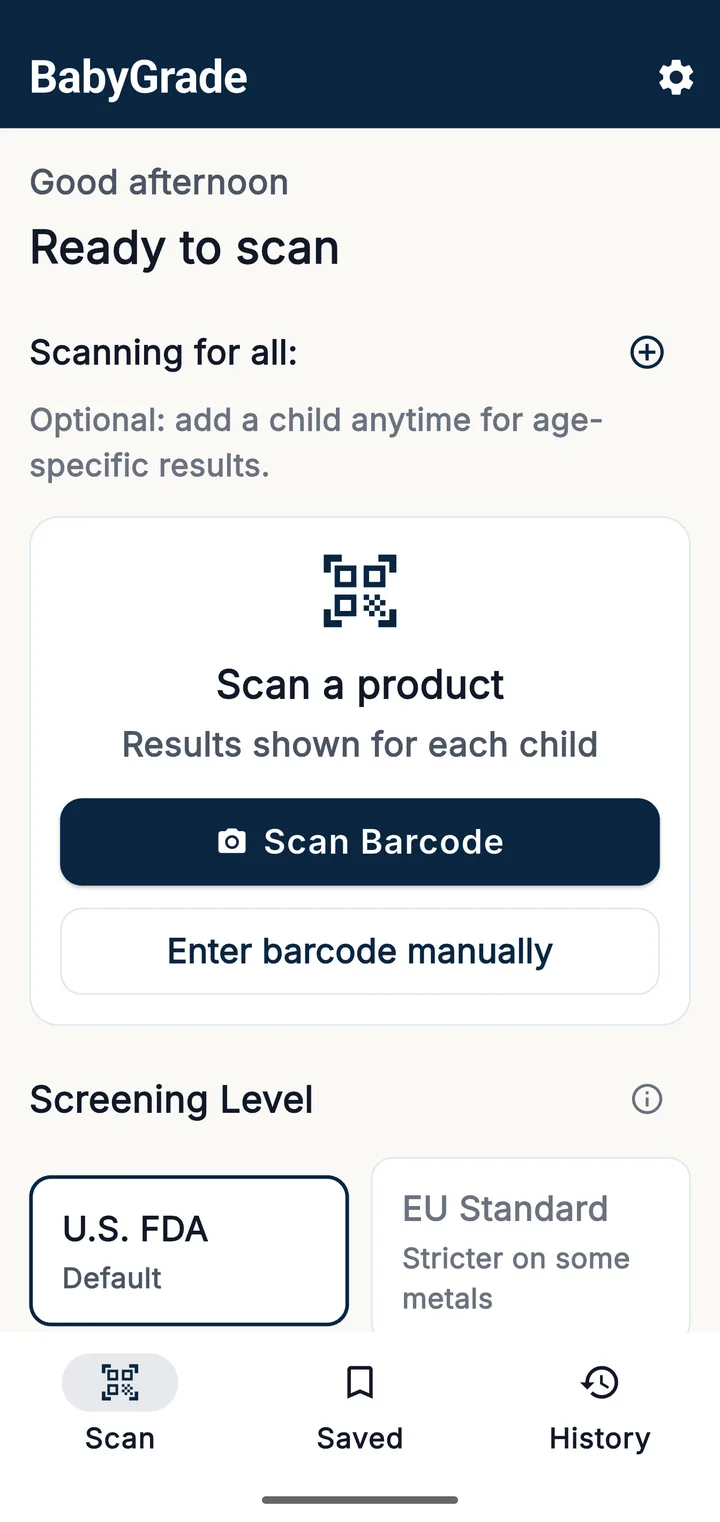
Point your camera at any baby food barcode. Seconds later you have a 0-100 score checked against FDA heavy-metal limits, pediatric guidance, and additive research, with a plain answer, graded Excellent to Poor. Free and unlimited. No account needed.
ONE EMAIL AT LAUNCH · NO SPAM · NO BRAND PARTNERSHIPS
Stage 2, 4 oz pouch · Illustrative example
The shelf, on the record
Three products you will meet in aisle 7. Same shelf, very different records. Representative examples, scored with the published BabyGrade method.
Stage 2, single-ingredient pouch
One whole-food ingredient. No added sugar. Root vegetables are screened against the tighter lead benchmark, and this category clears it.
FDA Closer to Zero · lead action levels, 2025
Freeze-dried toddler snack
Cane sugar and juice concentrate in the first ingredients. AAP guidance is zero added sugar before age two, so the sweetening score drags the total down.
American Academy of Pediatrics · added sugar guidance
Infant cereal, first stage
Often the first solid food a baby ever eats. Rice concentrates arsenic from soil and water, and typical products sit close to the FDA's arsenic action level for this category. Oat versions of the same first cereal test far lower.
FDA · inorganic arsenic action level, 2020
Record pending
The fourth record is the one in your cart. BabyGrade files it in seconds, the day you scan it.
Be there at launchRecall alerts are always free, for everyone. No subscription required.
quality dimensions checked on every scan, weights published
— Methodology, in full, at babygrade.net/methodology
recall alerts for every parent, subscriber or not
— Synced from FDA enforcement reports
from barcode scan to a verdict you can act on
— At the shelf, before the pouch is in the cart
How it works
Three steps. No typing. No waiting until you get home. Unlimited free scanning — no account or credit card required.
Open BabyGrade, point your camera at any baby food barcode. No typing. No searching. Works on store shelves.
BabyGrade cross-references the ingredient list against published benchmarks across contaminant levels, ingredient quality, additives, processing, and sweetening.
A single 0-100 score and a plain-language summary tell you exactly what we found and why. When we know of better-scoring options in the same category, we suggest up to three.
In hand
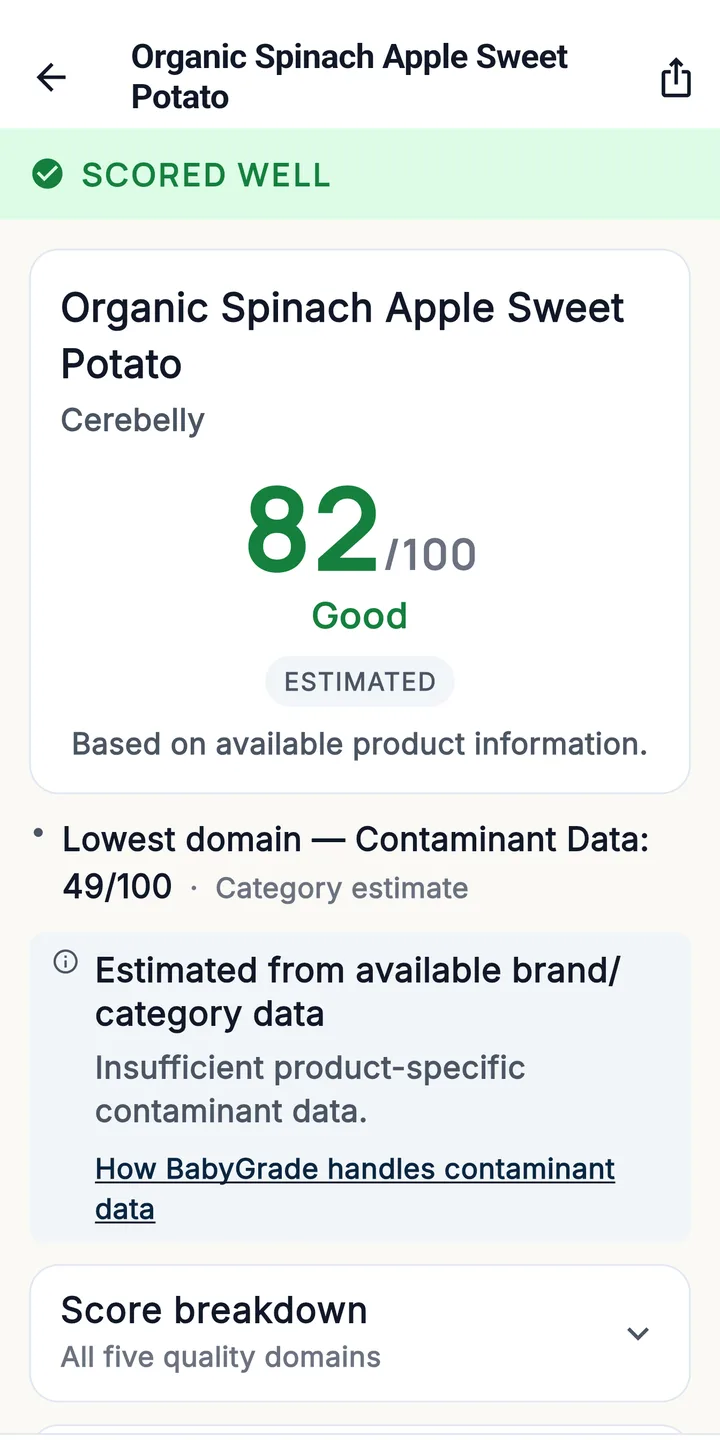
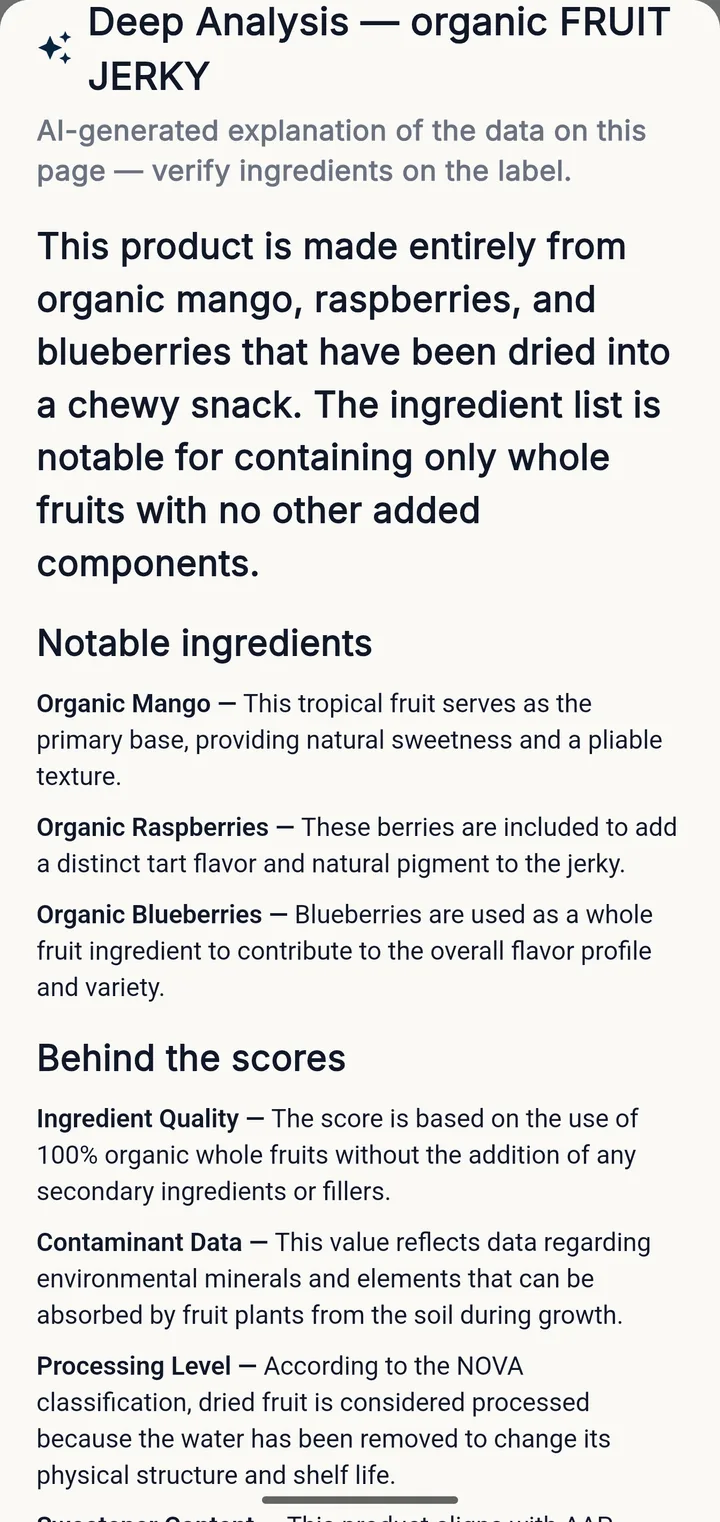
Actual screens from the Android app. One hand on the cart, one scan, one clear answer.
What other apps miss
Calorie counts and protein grams tell you nothing about lead levels or NOVA classification. BabyGrade is built for the questions that actually matter for infant nutrition. The nutrition label does not flag cadmium. We do.
Weighted methodology
Most competitors hide methodology behind a proprietary algorithm. BabyGrade publishes the weights. A weak result in any dimension pulls the score down, and a serious contaminant finding caps it outright.
Heavy metal levels for lead, arsenic, cadmium, and mercury, flagged against published FDA and EU reference values and high-accumulation ingredient categories.
Every ingredient evaluated individually. Whole, minimally processed foods score higher. Refined, low-quality fillers are identified and scored down.
Artificial colors, synthetic flavors, chemical preservatives, and thickeners are identified by name, categorized by concern level, and factored into the grade.
NOVA group classification applied to every product. Ultra-processed baby food receives lower scores regardless of how the label is marketed.
Added sugars, fruit juice concentrates, and high-glycemic sweeteners are detected and weighted against AAP guidance on added sugar for infants and toddlers.
Measured vs estimated
Contaminant evidence is not the same for every product. Some scores rest on lab measurements of that product or brand. Others are estimated from category data until measurements exist. BabyGrade marks the difference on every result, in plain sight.
No other baby food scanner makes that distinction visible.
A score that hides its uncertainty is marketing. A score that shows it is a record.
Score key
Every product gets a 0-100 score, a clear band, and a plain-language summary so you can decide at the shelf in seconds.
Comparative analysis
General food apps were not designed with infant food quality as the primary concern. BabyGrade was.
| Feature | BabyGrade | Yuka | Olive | Open Food Facts |
|---|---|---|---|---|
| Built specifically for infant food | ● | — | ● | — |
| FDA Closer to Zero thresholds | ● | — | — | — |
| Flags active product recalls | ● | — | — | — |
| Suggests up to three higher-scoring alternatives | ● | — | ● | — |
| Grounded in published federal data | ● | — | — | — |
Comparison based on publicly available features as of May 2026. Not affiliated with Yuka, Olive, or Open Food Facts.
Citation log
Brands cannot pay to change a score. A product either passes a benchmark or it does not.
Lead action levels for baby foods finalized in 2025; arsenic action level for infant rice cereal set in 2020. The FDA has not yet published action levels for cadmium or mercury in baby food.
Dietary guidelines for infants and toddlers, including added sugar limits, allergen guidance, and additive concerns by developmental stage.
Internationally validated system for measuring the degree of food processing across four groups. Applied to every product in the database.
Ingredient concern database covering thousands of food additives, preservatives, and synthetic compounds used across the food supply.
Foundation nutrient composition data used to evaluate ingredient quality and whole-food status at the ingredient level.
Subcommittee report documenting heavy metal levels in seven major baby food brands. 95 percent of tested products contained at least one heavy metal.
Statement of independence
BabyGrade has no advertising revenue. No brand partnerships. No sponsored scores. A product cannot buy a better grade. A parent can trust that.
There is no ad network. There is no ad revenue. The business model is a subscription, not data or attention.
No food manufacturer has a commercial relationship with BabyGrade. No sponsored placement, paid features, or promotional content.
Scores are calculated deterministically. There is no override mechanism. A brand cannot contact us to improve its grade.
We do not sell user data. We do not share scan history with third parties. Plain English privacy policy at babygrade.net/privacy.
Pricing
Scanning is free and unlimited, forever. The paid tiers add depth for the products you bring home.
Free
$0
Unlimited scanning, full scores, recall alerts
Pro
$3.99/mo
AI Deep Analysis, monitoring, full history
Expert
$8.99/mo
Allergen matching, comparison, age-ranked swaps
Common questions
We check five things: heavy metals, ingredient quality, additives, how processed the food is, and added sweeteners. Each has a published weight (30/25/20/15/10) and the five combine into one 0-100 score: Excellent (90 and up, measured contaminant data only), Good (80-89), Fair (60-79), or Poor (below 60). Every flag names its source, and every result shows whether its contaminant evidence is measured or estimated.
BabyGrade is free to download with unlimited free scanning — no account or credit card required to scan. Recall alerts are always free, for everyone. Optional subscriptions add more: Pro ($3.99/month or $34.99/year) unlocks AI Deep Analysis, unlimited saved products, full scan history, and saved-product monitoring; Expert ($8.99/month or $69.99/year) adds allergen matching, age-ranked alternatives, and side-by-side comparison.
Excellent (90 and up) is reserved for products whose contaminant evidence is measured; estimated data caps the label at Good, whatever the number. Good (80-89) means the product scored well across the five things we check. Fair (60-79) signals mixed results worth a closer look. Poor (below 60) means multiple quality flags were identified.
FDA Closer to Zero action levels, American Academy of Pediatrics guidelines, the NOVA food processing classification system, EWG Food Scores, USDA nutrient data, and the 2021 Congressional Subcommittee report on heavy metals in baby food.
No. We do not sell data, run ads, or have brand partnerships. We do not share scan history with third parties. Our full privacy policy is plain English at babygrade.net/privacy.
BabyGrade covers major national brands, certified organic brands, and store-brand products from large retailers. If a barcode will not scan, you can enter it manually, and if a result looks wrong or incomplete you can flag it directly from the app for review.
Scanning a recalled product surfaces the active recall notice and the specific reason, so you can check your package against the official FDA notice. Recall data is synced regularly from FDA enforcement reports. See our recalls article for the full picture.
The launch
Scan it before you buy it. BabyGrade launches soon, Android first. Enter your email and we will tell you the day it goes live. Free to download with unlimited free scanning. No credit card required. Recall alerts are always free, for everyone.
ONE EMAIL AT LAUNCH · NO SPAM · NO BRAND PARTNERSHIPS